Evaluate two Claude workflows.
Field extraction and questions about confirmed entries: errors, corrections, unwanted advice, and cost per workflow.
Trader Tool is a trade journal with data review before saving. We are developing it into a trader's workspace linking their own plan, market context, and reflection on results.
Today: reviewing and confirming a record.
The complete workspace is a vision, not a current capability.
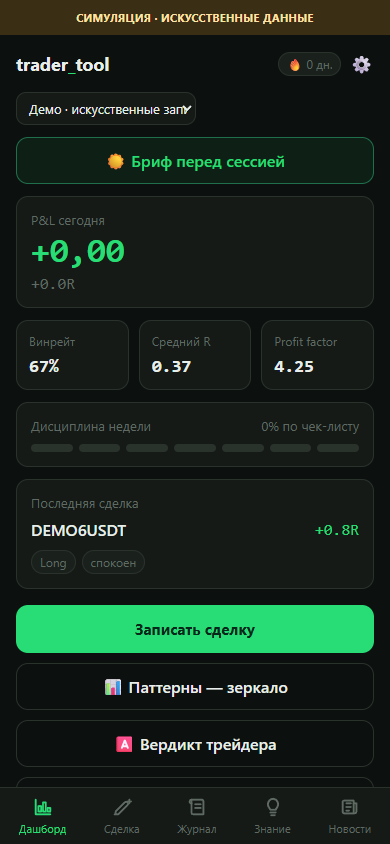
The interactive demo reuses existing React screens. Create and edit synthetic entries stored only in your browser, then reset them. AI text is prerecorded and labelled as simulation. The application UI is currently in Russian, with an English guide. This is not live Claude or a customer service.
For traders who save trade screenshots, use Telegram, and postpone manual journaling.
Value to test: reach a confirmed entry with less manual input, then return to recent entries for review.
This is a hypothesis. Spreadsheets and other journals remain alternatives: convenience, repeated use, and willingness to pay have not been compared.
The current prototype connects a trade draft, user review, explicit confirmation, and a view of the saved result.
Screenshot fields first become a draft. An unknown direction does not default to long. The user corrects the data before a record is saved.
In this demonstration, extraction and the assistant's response are mocked. The demo shows how the application handles those responses and user corrections.
Try the journal yourself →Current React screens, in Russian. All displayed numbers are synthetic. This page does not imply an English product UI.
A place to return to the journal and personal discipline.
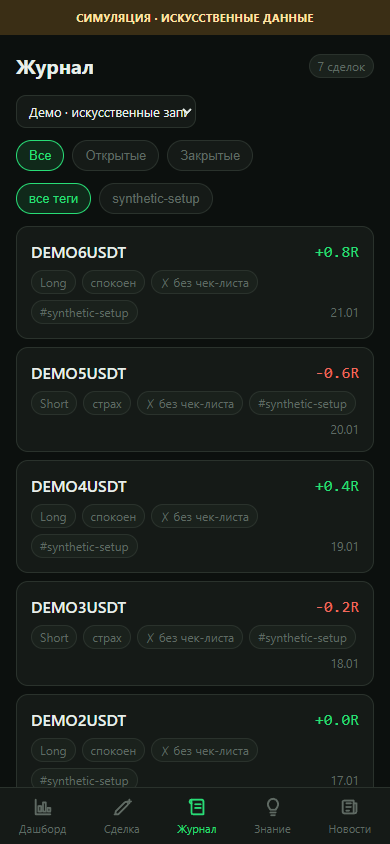
The trade, outcome, emotion, and setup tag beside one another.
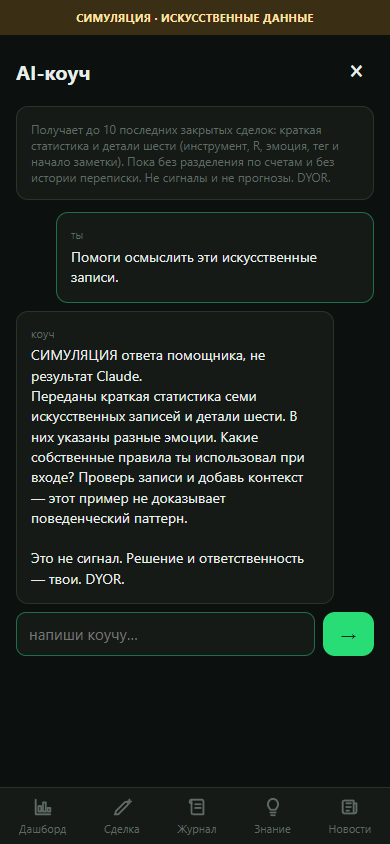
Intended to reflect on recent records and ask questions. Model behaviour still needs validation.
Not a magical all-in-one system. A traceable link between research, my own plan, and the result.
What am I observing?
When would I act or skip?
What would change my plan?
The proposed first connection attaches a timestamped Analysis snapshot to a user plan and journal entry. Later, expectations, actions, and results could be compared. No integration is implemented today.
The separate Analysis project's long-term goal is to test forecasting hypotheses on independent data. Accuracy, usefulness, and profitability are unproven. An honest research result can be negative.
Context helps me think.
The decision remains mine.
Public prototype materials. Internal notes, application drafts, Russian pages and private data are not included.